
The decline in multifamily values over the past five years has created an unusual opening, and it is one our platform is built to capture. We deploy what we call rescue capital.
The story behind these deals is consistent: good real estate sitting inside broken capital stacks. Owners are out of options and lenders are out of patience. That is where we step in. Rather than purchasing an asset outright, we join the current ownership group and provide the fresh equity needed to move the property forward and ride the cycle back up. In exchange for that capital, our LP capital is placed in the preferred position, ahead of all existing equity and LP positions that were raised when the deal first came together. Because of where values sit today, that capital enters at a discount to current value, with last dollar exposure that reflects the discount.
The result is a protected seat. We are not relying on a market recovery to make these deals work. We are stepping into solid properties at a discount, in the most protected equity position available, and operating them ourselves with our own management and construction teams.
The approach is scaling, and Creekside is the reason. Its early success has proven out a strategy most operators are not built to run. We approach this market differently: we are not chasing the same deals as everyone else, but working a narrow niche where good assets sit in broken capital stacks and where our structure and our operating platform give us an edge. Word is spreading. We currently have $15 to $20 million in the pipeline, and it is growing every week.
The deal
In March 2026 we put this thesis to work in Dallas. Creekside is a 249-unit Class A community built in 2013 and sitting in a strong, well located submarket. The real estate was never the problem. The capital structure was. Ownership had reached the point where the property could no longer service its debt, and with no free cash there was no way to turn units and keep the property leasing. A 2013 Class A asset in a location like this should not be struggling, but a broken capital stack had starved it of the cash it needed to operate. What it needed was an influx of fresh equity to keep it alive and get it back on track.
That is exactly what we provided. We structured the recapitalization around a conservative pro forma that assumed 80.0% occupancy and $118,763 of June NOI. We placed our capital in the preferred position, took over operations, and moved management and construction onto our own teams. From there the work was operational: funding the make ready work so units could finally turn, leasing the property toward stabilization, holding expenses below plan, and executing the business plan directly rather than depending on the group that had run into trouble.
Performance: four months in
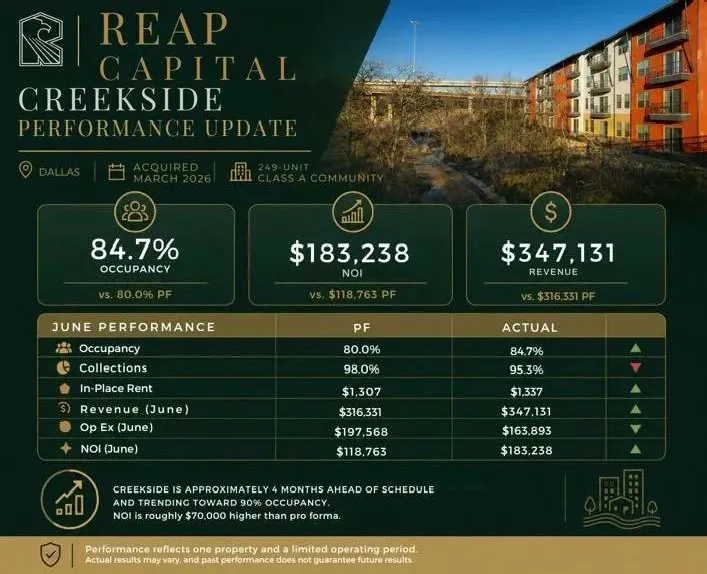
Four months into our ownership, Creekside is running ahead of plan on nearly every line of the model. June occupancy came in at 84.7% against the 80.0% pro forma, and the property is trending toward 90%. In place rent reached $1,337 against the $1,307 plan. Operating expenses landed $33,675 under budget for the month. June NOI came in at $183,238 against the $118,763 pro forma, roughly $65,000 of outperformance in a single month on a single asset.
Collections registered at 95.3% against the 98.0% assumption, the one metric tracking modestly behind plan, and one we are addressing directly through operations. By our internal measure, Creekside is approximately four months ahead of schedule.
The road ahead
Creekside is one asset, but the conditions that created it are widespread and, if anything, intensifying. Values dislocated over the past several years, floating rate debt has reset higher, and a large volume of loans is coming due into a market that will not refinance them on their original terms. Over the next six to twelve months we expect that pressure to push a steady stream of good properties into the same corner Creekside was in: sound real estate trapped inside a capital structure that no longer works. That is the window we are built for, and it is opening wider, not closing.
We are already seeing more of these situations than we can take, and the flow is accelerating. It reaches us because of who we know. Lenders looking for a credible operator to step in, sponsors who need a partner rather than a buyer, and brokers who know we can actually close and run the asset bring these deals to us directly, often before they are ever marketed. That network is the difference between reading about the opportunity and being first in line for it.
The common thread across all of them is the same lesson Creekside taught: these are good assets that need operational help, not broken real estate. The buildings are sound and the locations are strong. What failed was the capital, and in many cases the operations layered on top of it. We address both. We come in at the protected level of the stack and run the property with our own teams, which is why we can underwrite to conservative numbers and still deliver results like the ones above. Over the next year, we intend to do this again and again.
Performance reflects one property and a limited operating period. Actual results may vary, and past performance does not guarantee future results. This document is for informational purposes only and does not constitute an offer to sell or a solicitation of an offer to buy any security.
